Get to know the candidates
Filter By District
School board elections in Minneapolis are held every two years. In 2026, Districts 1, 3, 5, and two at-large seats are up for election.
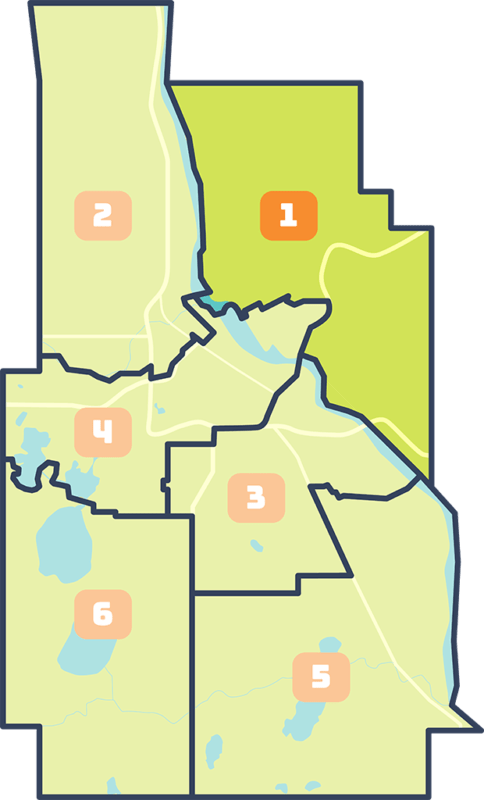
District 1
Includes all of Northeast and most of University.
- Edison High
- Las Estrellas Elementary
- Northeast Middle
- Pillsbury Elementary
- Pratt Elementary
- Waite Park Elementary
- Webster Elementary

Ben
Lattimore
District 1
Responses reflect candidates’ own views, and are not a reflection of Get On Board or any partner organizations.
Tell us about yourself and why you are running for MPS school board.
I have a strong desire to bring a fresh perspective to MPS. Our district is in a tough spot financially. Our students, teachers, and community need leaders who they know have their best interests both at heart and in mind. I realize how impactful local politics can be. Most inequities we see in our lives – from education to housing to healthcare – can be traced back to a deliberate policy decision.
My background is most recently in teaching high school business education. I have taught in public, private, and charter schools. I have taught in urban and suburban schools. My first teaching job was substitute teaching in MPS. I have seen district-level administrative policies that work for students and teachers, and I have seen policies that do not work.
Prior to teaching, I worked in a sales strategy and trade role for a local CPG manufacturer. I have a business degree from the University of Minnesota – Carlson School of Management. My combination of teaching and business experiences give me the unique ability to humanize students and empathize with teachers without romanticizing the current financial realities of the district. MPS needs someone with this balanced perspective to successfully navigate the difficult decisions that will need to be made over the next few years.
In the classroom, I have seen firsthand the detrimental effects of 1:1 classroom tech. There has been a lot of recent, peer-reviewed research that has shown 1:1 school-issued devices (i.e., laptops and tablets) have a detrimental impact on student learning and academic outcomes. My main pedagogical initiative for the district would be to lessen our emphasis on 1:1 tech, especially in K-8 schools.
What are your thoughts on giving individual schools more autonomy over budget, staffing, curriculum, and scheduling decisions? What are the benefits and risks of school-level flexibility?
During a budget shortfall, individual school leaders have a valuable perspective on what positions are critical for daily building operations. School leaders are more in-tune with their local community and what they value. If a school wants to prioritize their Title I instructional supports, for example, they should have a seat at the table to voice that concern. They should be included in discussions.
At the same time, MPS has had a series of well-documented accounting issues over the last 18 months. We cannot afford to decentralize budget autonomy to the point where we do not have proper controls in place on budgets of each school.
It is important to ensure fairness and equity in the budget and staffing process. It should be a partnership between district-level and building-level administrators. If we give an individual building full autonomy over staffing, how are we ensuring that a probationary teacher of color is receiving a fair and equitable evaluation? There should be some oversight from a district level.
When districts face budget crunches, younger probationary teachers often get the short end of the stick. We must ensure, for the long-term health of our district, that we are not trying to address the budget crisis by simply pink-slipping younger teachers who lack tenure.
On curriculum, I believe teachers are trained and licensed professionals and should be allowed the freedom to design their own curriculum. If we want to retain educators, then we need to let them hone their focus on what they came into the profession to do: teach. They do not need to be submitting daily lesson plans to the building admin team.
MPS enrollment has dropped by roughly 8,000 students since 2017, and it is projected to keep declining. Is increasing enrollment a viable solution to the budget crisis? If yes, what's your strategy? If no, how would you rightsize the budget instead?
To increase revenue, we must get creative to attract more students. Around 15% of MPS’ resident students open enroll at suburban schools. MPS must continue to innovate in order to better compete with other surrounding districts. The CTE and Career Development programs at Edison are great examples of ways MPS has started to differentiate and provide opportunities to students. As a business ed teacher, I have seen the value in CTE programming firsthand. Investing in programs like these should become the norm districtwide.
There needs to be a full review of MPS’ billing and coding processes. It has recently become widely known that MPS has missed out on millions of dollars in potential special education reimbursements for several years. These are not just lost dollars. These are lost years of special ed teachers, paraprofessionals, and accommodation resources that could have helped kids who need it most. I imagine there are likely other, similar errors that could increase MPS’ budget.
Rightsizing the budget requires a combination of district- and building-level administrators, teachers’ union reps, and community leaders partnering together to make tough decisions. The final decision-makers should be the school board, freely elected by the people and for the people.
There is work to be done by MPS to lobby the state legislature for changes in open enrollment policy. Other states carry a small fee for those who wish to pursue that opportunity, and it would prevent per-pupil school funding dollars from leaving Minneapolis schools entirely.
What do you see as the role of parent, student, and community voice in decisions that affect the Minneapolis Public Schools?
Parents want what is best for their child. They should be listened to in a constructive, organized manner. It feels like school board meetings in parts of the state and country have turned into political theatre. I like to think that Minneapolis parents and community members recognize that spending time and energy trying to ban books like The Great Gatsby is time and energy wasted.
I encourage parents to get involved with their local schools’ PTAs, site councils, and parent advisory councils. Taking ownership and resisting apathy is how we get MPS back on track. Those bodies should be acknowledged and listened to, otherwise people will lose their voice.
Students should be able to voice their concerns as well. There are actually two students who serve on the board as ex officio members. They have the chance to join discussions and share the students’ point of view. While they do not formally vote, they represent students across the district, and their views should be listened to and valued.
I would like to see high school students represented in faculty interviews (teaching and administrative positions). While they would not have formal hiring power, it is important for faculty to see what students value in a candidate and for students to practice using their voice. Providing students the chance to shadow the job interview process will help them learn what professional interviewing looks like as they get closer to entering the workforce themselves. I experienced students in the interview room firsthand, for a teaching position at a suburban public school, and I found it to be a great experience for everyone involved.
A recent poll found that over 90% of parents are concerned that children in MPS are not reading on grade level. What steps will you take to address these concerns and improve grade-level reading?
The most important thing is lifting student math and reading scores across the district, especially at the K-8 levels where so much of the brain development happens. By the time kids are in high school, if they have not received proper phonics instruction, it may be too late to make a strong impact on reading.
My main policy proposal would be to dramatically reduce our emphasis on 1:1 student-issued classroom technology (i.e., laptops and tablets). It has been reinforced in dozens of peer-reviewed academic research journals how much harm is being done to student learning with the emphasis on classroom tech. The “EdTech” industry is not the solution to grade-level reading; it is a huge problem. I am writing my master’s thesis on this, and the more I read about it, the more it alarms me. I encourage everyone to read Jonathan Haidt (Anxious Generation) and Jared Cooney Horvath (Digital Delusion).
In general, providing students with tech access due to worries of them potentially not being ready for the “digital workforce” are overblown. Tech companies have an incentive to build these tools–like AI chatbots–with easy-to-use interfaces. K-8 students need to be focused on the basics. Ditch the computers and tablets. Bring back physical books and paper worksheets. Less distractions. More learning.
Know Your Ballot
All Minneapolis residents can vote for an at-large candidate, but you can also vote for a district-specific candidate.